"Outsider", "Self-Taught" or "Outlier"? The Labels Debate
Why the term "outsider art" is argued over, what people use instead, and how to talk about the work respectfully.

By The Outsider Artist editors, Editorial team, Website Studio
Updated
· Last reviewed · 3 min read
In short
- "Outsider art" is criticised for defining people by exclusion and for turning illness, poverty or disability into a selling point.
- Roger Cardinal, who coined the English term in 1972, never much liked it and later said it had been overused.
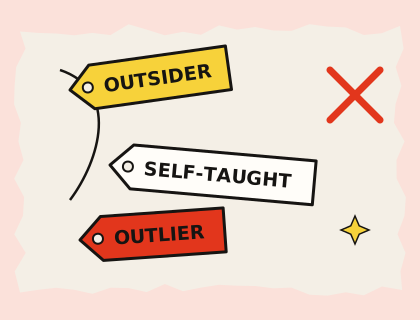
- In 2018 the National Gallery of Art in Washington used "outliers" instead, in the exhibition Outliers and American Vanguard Art.
- "Self-taught art" is the most neutral alternative and is widely used by museums and auction houses.
- Many artists described as outsiders never chose the label; it is usually applied by others, often after their death.
What is wrong with "outsider art"?
The objections come from several directions:
- It defines people by what they are not. "Outsider" describes a relationship to the art world, not the art. It puts the art world at the centre and everyone else at the edge.
- It can exploit vulnerability. Biographies of illness, poverty, disability or imprisonment are often used to sell the work, sometimes more than its qualities.
- It is often inaccurate. Many so-called outsiders were connected to churches, communities, popular culture or other artists. Bill Traylor drew the life of Montgomery's streets; Madge Gill exhibited at the Whitechapel Gallery.
- It is applied by others. Few artists call themselves outsiders. The label is usually given by collectors, dealers or museums, and often after the artist has died.
- It has become a market category. Dealers can use it for anything untrained or eccentric, which blurs its meaning.
What did Roger Cardinal think of the term?
Cardinal accepted "Outsider Art" as a compromise book title in 1972. He had wanted to keep the French art brut. Over the following decades he watched the term spread far beyond what he meant, and he said so. The irony is that the person most associated with the term was among its most thoughtful critics. See Roger Cardinal and outsider art.
What does "outlier" mean?
In 2018 the National Gallery of Art in Washington, DC, staged Outliers and American Vanguard Art, curated by Lynne Cooke. It showed around 250 works by more than 80 trained and self-taught artists made between 1924 and 2013, and argued that the boundary between them had always been porous. Cooke proposed "outlier" because it had no history of negative use and implied a relationship to the mainstream rather than exclusion from it. The term has been taken up by some writers and institutions, though "outsider" remains far more common.
What other terms are used?
- Self-taught art
- Describes how the artist learned. It is neutral and widely used, though it also fits many celebrated trained painters who taught themselves after leaving school.
- Art brut
- Dubuffet's original, stricter term, still used by the Collection de l'Art Brut in Lausanne and by many European institutions.
- Intuitive art
- Used by Intuit, the Center for Intuitive and Outsider Art in Chicago.
- Visionary art
- Used by the American Visionary Art Museum in Baltimore; it emphasises inner vision.
- Art singulier
- A French term for independent, self-taught artists working in a raw style, often shown at the Halle Saint Pierre in Paris.
- Marginal or non-traditional arts
- Used by some UK organisations and writers to describe artists facing barriers to the art world.
How do UK organisations talk about it?
The UK charity Outside In, founded at Pallant House Gallery in Chichester in 2006, works with artists who face barriers to the art world because of health, disability, social circumstances or isolation. It focuses on the barrier rather than the person, and it lets artists decide for themselves whether to identify with the outsider label. Many supported studios do the same. See supported studios.
How should you talk about outsider artists?
- Name the artist and describe their work before their diagnosis or circumstances.
- Use their own words where possible, and the term they prefer if they are living.
- Be accurate about biography; avoid romantic myths of the lone genius or the "mad" artist.
- Explain the term when you use it, as this site does, rather than treating it as a fact about the person.
Why does this site still use "outsider art"?
Because it is the term most people know and search for, and because it has a real history. We use it as a doorway into the subject, explain where it came from, and try to let the artists speak for themselves. If you think we have got the language wrong anywhere, tell us.
Where to go next
Compare the terms in art brut vs outsider art, or read about ethics, the market and hoaxes.
Questions and answers
Why is the term "outsider art" controversial?
Critics say it defines artists by exclusion, can exploit illness, poverty or disability, and is usually applied by others rather than chosen by the artists. Many museums now prefer "self-taught art", and the National Gallery of Art used "outliers" in 2018. Read the debate.
Sources and further reading
Didn't find your answer?
Ask us about outsider art, an artist, a place or UK graffiti. We read every question, and the most useful ones are answered on the site.