Madge Gill and Myrninerest: Britain's Best-Known Outsider Artist
An East London medium who made thousands of intricate ink drawings, some on rolls of calico many metres long, and said they belonged to her spirit guide.

By The Outsider Artist editors, Editorial team, Website Studio
Updated
· Last reviewed · 4 min read
In short
- Madge Gill (1882–1961) was a self-taught artist and Spiritualist medium from East London.
- From 3 March 1920 she said a spirit guide called Myrninerest directed her drawing, and she signed many works with that name.
- She made thousands of pen-and-ink drawings, from postcards to rolls of calico many metres long, along with embroidery and textiles.
- She exhibited at the Whitechapel Gallery's East End Academy shows in the 1930s and 1940s but rarely sold her work.
- Her work is held by Newham Council, the Whitworth in Manchester and the Collection de l'Art Brut in Lausanne.
Who was Madge Gill?
Madge Gill was born Maud Ethel Eades in 1882 in East London, to an unmarried mother. Her family hid her birth, and she was raised largely out of sight by an aunt and her grandmother. At about nine she was placed in an orphanage, and as a girl she was sent to work in Canada as a child migrant. She returned to London in 1900, worked as a nurse at Whipps Cross Hospital in Leytonstone, and married her cousin Thomas Gill. They had three sons.
Her life was marked by loss. In 1919 her only daughter died at birth, and a serious illness followed, during which she lost the sight in one eye. Her aunt had introduced her to Spiritualism when she was young, and it became central to her life.
Who was Myrninerest?
On 3 March 1920, some weeks after her recovery, Gill said she was "possessed" by a spirit guide she called Myrninerest. From then on she drew, wrote, played the piano and embroidered under Myrninerest's direction, often for hours at a time, late into the night. She signed many works "Myrninerest" rather than with her own name.
Because she believed the work belonged to her guide, she was reluctant to sell it. In 1939 the Evening Standard reported that the East End artist would not sell her work, even an eight-foot embroidered carpet valued at £200.
What does Madge Gill's art look like?
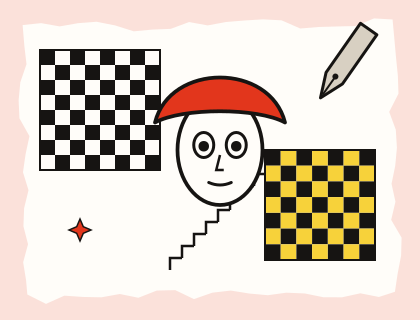
Gill's drawings are instantly recognisable. Pale female faces, often in elaborate hats, float among dense chequerboard patterns, staircases and architectural shapes that seem to pull the eye into a dizzying space. She worked mostly in black ink with a fine pen, on anything from postcards and card to vast rolls of calico, some of them many metres long, which she unrolled bit by bit as she drew. She also made embroideries and knitted and woven textiles.
The repeated female face has been read in many ways: as Myrninerest, as Gill herself, or as the daughter she lost. Gill never explained it.
Did Madge Gill exhibit in her lifetime?
Yes. She showed work at amateur art exhibitions in the East End, and between 1932 and 1947 she exhibited drawings at the Whitechapel Gallery's annual East End Academy open exhibitions, often including very large calicos. She was known locally, but her work was largely ignored by the art establishment while she was alive. She died in Leytonstone in January 1961.
How did Madge Gill become famous?
After her death, much of her work was found in her home, and a large collection, nearly 2,000 drawings, passed to Newham Council's archive. Jean Dubuffet had already added her work to the art brut collection, and Roger Cardinal wrote about her in his 1972 book Outsider Art and later in a study of her life. She was one of the artists in the Hayward Gallery's 1979 Outsiders exhibition. See Roger Cardinal and outsider art.
Exhibitions in her home area have brought her back to East London audiences, including Madge Gill: Medium and Visionary at Orleans House Gallery in 2013 and the landmark Madge Gill: Myrninerest at the William Morris Gallery in Walthamstow in 2019, curated by Sophie Dutton.
Where can you see Madge Gill's work?
- The Whitworth, Manchester: works entered its collection with the Musgrave Kinley Outsider Art Collection in 2010.
- Newham Council archive: the largest holding, shown in exhibitions and loans.
- Collection de l'Art Brut, Lausanne: for many years the main place to see her work.
- Temporary exhibitions in London and elsewhere; check our where to see directory and journal.
Why does Madge Gill matter?
Madge Gill is the classic British outsider artist: self-taught, working-class, working for decades with almost no audience and no thought of selling. Her work is technically astonishing and emotionally powerful. Her story also shows how Spiritualism gave some women a language for creativity at a time when few other routes were open to them.
Key dates
| Year | Event |
|---|---|
| 1882 | Born Maud Ethel Eades in East London |
| 1900 | Returns to London; later works as a nurse at Whipps Cross Hospital |
| 1919 | Her daughter dies at birth; a serious illness follows |
| 1920 | On 3 March, says she is first guided by the spirit Myrninerest |
| 1932–1947 | Exhibits at amateur East End shows and the Whitechapel Gallery |
| 1939 | Evening Standard reports she will not sell her work |
| 1961 | Dies in Leytonstone in January |
| 1972 | Featured in Roger Cardinal's book Outsider Art |
| 1979 | Included in the Hayward Gallery's Outsiders exhibition |
| 2010 | Works enter the Whitworth with the Musgrave Kinley collection |
| 2019 | Madge Gill: Myrninerest at the William Morris Gallery, Walthamstow |
Where to go next
Read about mediumistic art, meet the other British outsider artists, or plan a visit with where to see outsider art in the UK.
Sources and further reading
Didn't find your answer?
Ask us about outsider art, an artist, a place or UK graffiti. We read every question, and the most useful ones are answered on the site.