Adolf Wölfli: The 25,000-Page Universe of an Art Brut Pioneer
A Swiss farm labourer who spent 35 years in a psychiatric clinic and created an illustrated universe of words, pictures and music running to about 25,000 pages.

By The Outsider Artist editors, Editorial team, Website Studio
Updated
· Last reviewed · 4 min read
In short
- Adolf Wölfli (1864–1930) was a Swiss artist, writer and composer who lived at the Waldau psychiatric clinic near Bern from 1895 until his death.
- His main work, the St Adolf Giant Creation, runs to about 25,000 pages in 45 large volumes and 16 school notebooks.
- He combined drawing, writing, collage and his own musical notation, which he played on a rolled paper trumpet.
- His psychiatrist Walter Morgenthaler published a book about him in 1921, one of the first to treat a patient as an artist.
- Most of his work is held by the Adolf Wölfli Foundation, founded in 1975 at the Kunstmuseum Bern.
Who was Adolf Wölfli?
Adolf Wölfli was born on 29 February 1864 in Bowil, near Bern in Switzerland. His childhood was brutal. His family was poor, he was abused, and after his parents' family broke up he was placed with a series of farming families as a child labourer. As a young man he worked as a farmhand and labourer.
In 1890 he was convicted of sexual offences against young girls and imprisoned for two years. After a further similar charge in 1895, he was sent to the Waldau clinic near Bern to be examined, and diagnosed with what doctors then called dementia paranoides, a form of schizophrenia. He remained at Waldau for the rest of his life, 35 years.
How did Wölfli start making art?
Wölfli began drawing at Waldau some years after his admission. His earliest surviving works, a series of about 50 pencil drawings, date from 1904 to 1906. He drew mainly in pencil and coloured pencil, often on large sheets of newsprint, and his work grew steadily in ambition and scale.
What is the St Adolf Giant Creation?
From 1908 until his death, Wölfli worked on an enormous, invented autobiography that he called the St Adolf Giant Creation. In it, the poor farm boy becomes a world traveller, a hero and finally a saint, "St Adolf II", ruling over a vast cosmos of his own design. It runs to about 25,000 pages, bound in 45 oversized volumes and 16 school notebooks, with around 1,600 illustrations and 1,500 collages.
The work falls into stages. His imaginary childhood journeys around the world came first. From 1912 to 1916 he worked on the Geographical and Algebraic Books, about 3,000 pages describing the creation of his future world. From 1917 to 1922 came the Books with Songs and Dances, about 7,000 pages celebrating it. He was still working on the final books when he died.
What does Wölfli's art look like?
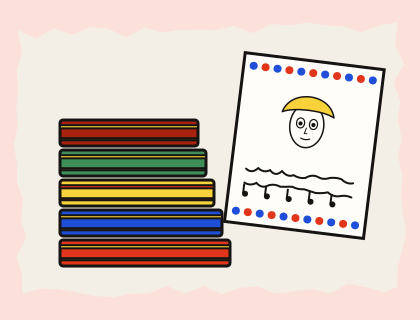
Wölfli's drawings are dense, symmetrical and packed with detail. Bands of ornament frame cathedrals, maps, figures and small mask-like faces. Words run through the pictures, along with numbers and long lists. He drew in coloured pencil, cut in pictures from magazines, and used a musical notation he invented, which he performed on a trumpet rolled from paper. Musicians have since recorded his compositions.
How did Wölfli become known?
His psychiatrist at Waldau, Walter Morgenthaler, took a serious interest in him. In 1921 Morgenthaler published Ein Geisteskranker als Künstler ("A psychiatric patient as artist"), which presented Wölfli as an artist rather than just a case. The book was read by artists across Europe.
Jean Dubuffet visited Waldau and included Wölfli in the founding of art brut; his work featured in the 1949 Paris exhibition. In 1972 the curator Harald Szeemann showed Wölfli at documenta 5 in Kassel, which brought him to an international audience. Read more in art from the asylum.
Where can you see Wölfli's work?
After his death on 6 November 1930, his works stayed at Waldau's own museum until 1973, when they were transferred to the Museum of Fine Arts (Kunstmuseum) in Bern. The Adolf Wölfli Foundation was set up there in 1975 and holds most of his output, including the books and over 1,500 drawings. Smaller groups of work are in the Collection de l'Art Brut in Lausanne and the American Folk Art Museum in New York. In 2021 the Zentrum Paul Klee in Bern showed all of his notebooks together for the first time.
In the UK, Wölfli's work has appeared in major loan exhibitions rather than permanent displays. See outsider art museums in Europe and the US.
Why does Wölfli matter?
Wölfli is often called the first great art brut artist. His work shows how far one person, working alone with almost nothing, could build a complete and consistent world. It also raises the hard questions that run through the field: his art cannot be separated from his crimes, his illness or his confinement, and his story should be told honestly rather than romanticised.
Where to go next
Compare Wölfli with Henry Darger, another builder of an epic private world, or read about the psychiatrists who collected patients' art in art from the asylum.
Sources and further reading
Didn't find your answer?
Ask us about outsider art, an artist, a place or UK graffiti. We read every question, and the most useful ones are answered on the site.