Graffiti and the Law in the UK
Graffiti without permission is a crime across the UK. A plain-English guide to the laws in England and Wales, Scotland and Northern Ireland.

By The Outsider Artist editors, Editorial team, Website Studio
Updated
· Last reviewed · 3 min read
In short
- In England and Wales, graffiti without the owner's permission is criminal damage under section 1 of the Criminal Damage Act 1971.
- Where the damage is valued under £5,000, the case is heard in a magistrates' court, with a maximum of 3 months in prison or a level 4 fine (£2,500).
- For more serious damage tried in the Crown Court, the maximum sentence is 10 years in prison.
- Councils and police can issue fixed penalty notices for graffiti; the default amount in England and Wales is £75 unless the council sets its own.
- Selling spray paint to anyone under 16 is an offence in England and Wales and in Scotland.
This page is general information, not legal advice. Laws and sentencing can change. If you are facing a charge, speak to a solicitor.
Is graffiti illegal in the UK?
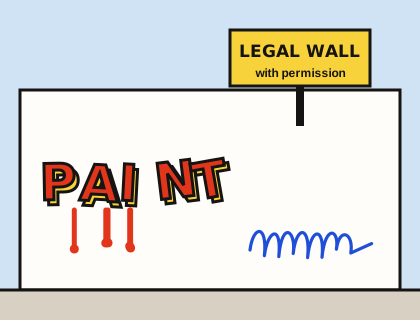
Painting, writing or marking any surface without the permission of its owner is illegal throughout the UK. The law does not distinguish between a scrawled tag and a skilled mural: what matters is permission. With the owner's consent, graffiti and street art are legal, although planning rules can apply to large murals in some places.
What is the law in England and Wales?
Graffiti without permission is criminal damage under section 1 of the Criminal Damage Act 1971, which makes it an offence to destroy or damage property belonging to someone else without lawful excuse. It is a recordable offence, and anyone caught can be arrested.
How a case is dealt with depends mainly on the value of the damage:
| Value of damage | Where it is heard | Maximum penalty |
|---|---|---|
| Under £5,000 | Magistrates' court | 3 months' imprisonment or a level 4 fine (£2,500) |
| £5,000 or more | Magistrates' or Crown Court | Up to 10 years' imprisonment in the Crown Court |
Young people aged 10 to 17 are dealt with in the youth justice system. Courts can also order offenders to pay compensation or to do unpaid work, which may include cleaning graffiti.
What are graffiti fixed penalty notices?
Under the Anti-social Behaviour Act 2003, authorised council officers and police community support officers can issue a fixed penalty notice for graffiti instead of prosecuting. Paying it means no criminal conviction. Since the Clean Neighbourhoods and Environment Act 2005, councils in England and Wales set their own amount; if they do not, the default is £75. Some councils offer a discount for early payment.
Is it illegal to sell spray paint to children?
Yes. In England and Wales, section 54 of the Anti-social Behaviour Act 2003 makes it an offence to sell an aerosol paint container to anyone under 16. Scotland has a similar offence under section 122 of the Antisocial Behaviour etc. (Scotland) Act 2004, with a maximum fine at level 3 on the standard scale. Sellers have a defence if they took all reasonable precautions.
What is the law in Scotland?
In Scotland, graffiti is usually prosecuted as vandalism under section 52 of the Criminal Law (Consolidation) (Scotland) Act 1995, which makes it an offence to wilfully or recklessly destroy or damage another person's property without reasonable excuse. In the sheriff court the maximum is 3 months' imprisonment for a first offence and 6 months for a later one, or a fine, or both. The common law crime of malicious mischief may also be used.
What is the law in Northern Ireland?
In Northern Ireland, graffiti without permission is dealt with under the Criminal Damage (Northern Ireland) Order 1977, which mirrors the criminal damage law of England and Wales. As elsewhere, a belief that the owner consented can be a lawful excuse.
Who has to remove graffiti?
Owners are generally responsible for removing graffiti from their own property, although many councils remove offensive graffiti or offer help. In England, councils' specific powers to serve graffiti and defacement removal notices were repealed in 2014, and councils now rely on other powers. Victims should report graffiti to the police as criminal damage and obtain a crime reference number, which may help with insurance.
Can graffiti artists keep copyright?
Generally, yes: an original artwork is protected by copyright even if it was painted illegally, although the law here is unsettled and rarely tested. Separately, the owner of the wall owns the physical paint on it, which is why building owners have sometimes removed and sold works by Banksy and others.
Where to go next
Find places to paint legally in legal graffiti walls in the UK, or read the history of graffiti in the UK.
Questions and answers
Is graffiti illegal in the UK?
Yes, without the permission of the owner of the surface. In England and Wales it is criminal damage under the Criminal Damage Act 1971; in Scotland it is usually prosecuted as vandalism. With the owner's permission, graffiti and murals are legal. Graffiti and UK law.
Sources and further reading
- Criminal Damage Act 1971
- Anti-social Behaviour Act 2003, section 44 (relevant offences for graffiti penalty notices)
- Clean Neighbourhoods and Environment Act 2005, section 28 (amount of penalty)
- Criminal Law (Consolidation) (Scotland) Act 1995, section 52 (vandalism)
- Antisocial Behaviour etc. (Scotland) Act 2004, section 122 (spray paint sales)
- Newcastle City Council: Graffiti
- Stuart Miller Solicitors: Criminal damage offences in England and Wales
Didn't find your answer?
Ask us about outsider art, an artist, a place or UK graffiti. We read every question, and the most useful ones are answered on the site.