Legal Graffiti Walls in the UK: Where Can You Paint?
There are fewer legal walls in the UK than most people think. Where they are, what "tolerated" really means, and how to paint legally.

By The Outsider Artist editors, Editorial team, Website Studio
Updated
· Last reviewed · 3 min read
In short
- Painting on any surface is legal only with the permission of the owner of that surface.
- Leake Street, a tunnel under London Waterloo, has been a legal graffiti space since the Cans Festival in May 2008; commercial advertising is not allowed.
- Glasgow City Council has run pilot legal graffiti walls at Custom House Quay, the Riverside Museum and Yorkhill.
- Bristol had no officially designated legal walls in 2025, despite its street art fame; some sites are only "tolerated".
- Leeds approved eight sites for legal street art in 2021, run by the Leeds Street Gallery collective.
What makes graffiti legal?
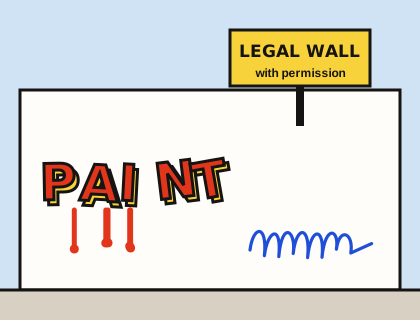
Permission. In UK law, painting on someone else's property without their consent is criminal damage, whatever its artistic quality. Painting with the owner's permission, whether that is a private owner, a business or a council, is not. A "legal wall" is simply a surface whose owner has given general permission for people to paint it, usually with some rules attached. See graffiti and UK law.
Where are the legal walls in the UK?
Official legal walls are rarer than many people assume, and they change, so always check current status before you paint.
- Leake Street, London
- A tunnel about 300 metres long under Waterloo station that has been a legal graffiti space since Banksy's Cans Festival in May 2008. It is one of the best-known legal walls in Britain and is repainted constantly. Rules posted at the entrance ban commercial advertising.
- Glasgow
- Glasgow City Council has run pilot legal graffiti walls at Custom House Quay, near the Riverside Museum and at Yorkhill, in areas previously used as unofficial walls. The council directs people to the Glasgow Legal Walls project for details.
- Leeds
- In 2021 Leeds City Council approved eight sites for legal street art, including walls under Mills Bridge and Richmond Bridge, to be painted by the Leeds Street Gallery collective. These are curated sites rather than open walls.
Other towns and skateparks have local permission walls. If you hear of one, check with the council or site owner first.
What about "tolerated" walls?
Some well-known painting spots are not legal walls at all, just places where graffiti has been tolerated. In 2025 Bristol City Council said the city had no legal walls, and that artists need express permission from the property owner. Spots such as the Dean Lane skatepark and the Mina Road tunnel in St Werburgh's have been painted for years, but they are a grey area: an artist was arrested at Mina Road in 2020. Tolerance can end at any time, and it is not a legal defence.
How can you paint legally?
- Use an official legal wall, and follow any rules posted there.
- Ask for permission from the owner of a wall, in writing if possible. Many businesses welcome a good mural.
- Join a festival or community project, such as Upfest, Weston Wallz or a council mural programme. See UK street art festivals.
- Go through a supported project; many youth organisations run legal graffiti workshops.
- Paint on boards or canvas to practise.
What etiquette applies at legal walls?
- Don't go over a good piece with a worse one; ask or wait if a wall is busy.
- Take your empty cans and rubbish away with you.
- Wear a mask suitable for paint fumes in enclosed spaces such as tunnels.
- Respect people who live and work nearby.
Where to go next
Read graffiti and UK law and find the best UK cities for street art.
Questions and answers
Where can you paint graffiti legally in London?
Leake Street, a tunnel under Waterloo station, has been a legal graffiti space since Banksy's Cans Festival in 2008. Anywhere else, you need the owner's permission. Legal walls in the UK.
Sources and further reading
Didn't find your answer?
Ask us about outsider art, an artist, a place or UK graffiti. We read every question, and the most useful ones are answered on the site.