Bill Traylor: The Artist Born Into Slavery Who Began Drawing at 85
Born enslaved on an Alabama plantation, Bill Traylor began drawing on a Montgomery pavement at about 85 and made more than a thousand works in three years.

By The Outsider Artist editors, Editorial team, Website Studio
Updated
· Last reviewed · 3 min read
In short
- Bill Traylor (about 1853–1949) was born into slavery on a plantation in Dallas County, Alabama.
- He began drawing around 1939, at about 85, while living on the streets of Montgomery, Alabama.
- Between 1939 and 1942 he made somewhere between 1,200 and 1,500 drawings and paintings on scraps of cardboard.
- The young white artist Charles Shannon met him in 1939, supplied materials and preserved most of his work.
- His work is the only substantial body of art known to have been made by a person born into American slavery.
Who was Bill Traylor?
Bill Traylor was born around 1853 on the plantation of John Getson Traylor in Dallas County, Alabama, near Benton. His parents were enslaved, and so was he. After emancipation he stayed on the land as a farm worker and sharecropper for most of his life, raising a large family.
In the 1930s, in his eighties, he moved to Montgomery, the state capital, where he worked in a shoe factory until rheumatism forced him to stop. He received a small public assistance payment and was effectively homeless, sleeping in the back of a funeral home and spending his days on the pavement of Monroe Street.
How did Bill Traylor start drawing?
Around 1939, at about 85, Traylor began drawing on pieces of cardboard and card he found, using a pencil and later poster paint. He sat on the street and drew what he saw and what he remembered. Over about three years, from 1939 to 1942, he produced somewhere between 1,200 and 1,500 works.
What does his art show?
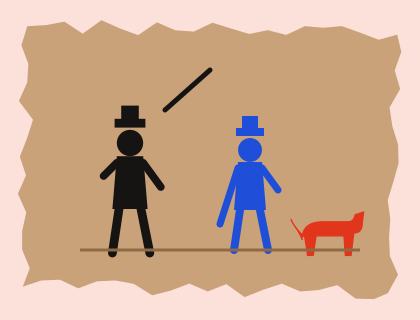
Traylor's pictures are made of bold, flat silhouettes: people, dogs, mules, horses, snakes, birds and houses, often in black, blue, red and brown against the bare card. Some are calm and simple, a single animal or figure. Others are packed with action: men chasing each other, figures with raised sticks, people drinking, pointing and fighting, animals in motion.
Scholars read them as a record of life between slavery and civil rights: memories of the plantation, the life of Montgomery's Black neighbourhood, and the violence of the Jim Crow South. He lived through slavery, Jim Crow and the violent death of one of his sons, and some drawings appear to carry that trauma. Traylor left no written explanation.
Who was Charles Shannon?
Charles Shannon was a young white painter in Montgomery who saw Traylor drawing on Monroe Street in 1939. He bought drawings, gave Traylor materials and collected most of what he made. In 1940 Shannon organised an exhibition of Traylor's work at New South, an artists' cooperative gallery in Montgomery, and in 1942 the work was shown in New York.
When Shannon joined the army in 1942, Traylor's drawing largely stopped. He went to live with his children in northern cities, returned to Montgomery after the war, lost a leg to gangrene and died in a nursing home in 1949. Shannon kept the drawings for decades and began bringing them to public attention in the 1970s.
How is Bill Traylor seen today?
Traylor is now regarded as one of the most important American artists of the 20th century, self-taught or not. His work is in major museums, including the Metropolitan Museum of Art and the Smithsonian American Art Museum. A double-sided painting set his auction record of $507,000 at Christie's.
Is Bill Traylor an outsider artist?
He is often called one, but the label is debated. Traylor drew the world around him and was part of a community on Monroe Street. Many writers now prefer "self-taught" for him. See the labels debate.
Key dates
| Year | Event |
|---|---|
| About 1853 | Born enslaved in Dallas County, Alabama |
| 1865 | Emancipation; continues as a farm worker and sharecropper |
| 1930s | Moves to Montgomery and works in a shoe factory |
| 1939 | Begins drawing on Monroe Street; meets Charles Shannon |
| 1940 | First exhibition at New South, Montgomery |
| 1942 | Work shown in New York; Shannon joins the army and Traylor's drawing largely stops |
| 1949 | Dies in Montgomery |
Where to go next
Compare Traylor with Martín Ramírez and Judith Scott, or read about ethics and the market.
Sources and further reading
Didn't find your answer?
Ask us about outsider art, an artist, a place or UK graffiti. We read every question, and the most useful ones are answered on the site.