Judith Scott: Fibre Sculptures That Spoke Without Words
Institutionalised for 35 years, Judith Scott found her voice at 44 by wrapping found objects in yarn and fabric. Her sculptures are now in major museums.

By The Outsider Artist editors, Editorial team, Website Studio
Updated
· Last reviewed · 3 min read
In short
- Judith Scott (1943–2005) was an American sculptor who had Down syndrome and was deaf.
- She spent about 35 years in a state institution in Ohio before her twin sister, Joyce, brought her to California in the mid-1980s.
- From 1987 she attended Creative Growth Art Center in Oakland, where a fibre art class introduced her to her medium.
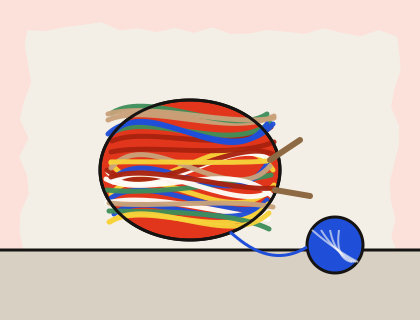
- She wrapped found objects in yarn, string, fabric and paper to make cocoon-like sculptures, nearly 100 in all.
- Her work has been shown at the Venice Biennale and the Brooklyn Museum and is held by museums worldwide.
Who was Judith Scott?
Judith Scott and her fraternal twin sister, Joyce, were born in Ohio on 1 May 1943. Judith had Down syndrome. She also lost her hearing in infancy, probably after scarlet fever, but her deafness was not diagnosed until she was in her thirties; until then her silence was mistaken for intellectual disability.
At seven she was separated from her family and placed in a state institution, where she spent about 35 years with little education or support. In the mid-1980s Joyce became her legal guardian and brought her to live in California.
How did Judith Scott start making art?
In 1987, aged 44, Judith began attending Creative Growth Art Center in Oakland, one of the first studios for artists with disabilities. For some time she showed little interest in art, making a few rhythmic drawings. Then she joined a workshop led by the visiting fibre artist Sylvia Seventy and discovered her medium. From then on she worked almost every day.
What do her sculptures look like?
Scott's sculptures begin with found objects: sticks, keys, fans, chairs, magazines, even, reportedly, a shopping trolley. She bound them together and wrapped them in layers of yarn, string, strips of fabric and paper until the original objects disappeared inside. The finished works look like cocoons, nests, pods or bundled bodies, some more than a metre long, in rich colours.
She worked with total concentration and decided for herself when a piece was finished. She made nearly 100 sculptures during her time at Creative Growth, continuing until her death in Dutch Flat, California, in 2005.
How was her work received?
Scott's sculptures quickly attracted attention beyond the outsider art world. She was the subject of a monograph by the art historian John MacGregor in 1999, and the Collection de l'Art Brut in Lausanne gave her a solo exhibition in 2001 to 2002. She was the first artist with Down syndrome to be shown at the San Francisco Museum of Modern Art.
After her death her reputation continued to grow. The Brooklyn Museum held a major exhibition, Bound and Unbound, in 2014 to 2015, and her work was included in the Venice Biennale in 2017 and the National Gallery of Art's Outliers exhibition in 2018.
Why does Judith Scott matter?
Scott's work is often cited as proof that serious art can come from anywhere. It also shows what supported studios can do: give an artist time, space and materials, then step back. Joyce Scott has spoken of art giving her sister a voice after decades of isolation.
Some critics ask whether her disability shapes how her work is seen and sold. Others argue that the sculptures stand on their own as some of the most original sculpture of their time. See the labels debate.
Where can you see Judith Scott's work?
- Creative Growth, Oakland, which manages her estate and archive.
- The Whitworth, Manchester, in the Musgrave Kinley Outsider Art Collection.
- Collection de l'Art Brut, Lausanne, and museums including the Smithsonian American Art Museum and the American Folk Art Museum.
Key dates
| Year | Event |
|---|---|
| 1943 | Born in Ohio on 1 May, with her twin sister Joyce |
| About 1950 | Placed in a state institution, where she spends about 35 years |
| Mid-1980s | Joyce becomes her guardian and brings her to California |
| 1987 | Joins Creative Growth Art Center in Oakland and discovers fibre art |
| 1999 | Monograph by John MacGregor |
| 2001–2002 | Solo exhibition at the Collection de l'Art Brut, Lausanne |
| 2005 | Dies in Dutch Flat, California |
| 2014–2015 | Bound and Unbound at the Brooklyn Museum |
| 2017 | Work shown at the Venice Biennale |
Where to go next
Read about supported studios and the UK studios working with artists today.
Sources and further reading
Didn't find your answer?
Ask us about outsider art, an artist, a place or UK graffiti. We read every question, and the most useful ones are answered on the site.