Nek Chand's Rock Garden of Chandigarh
A government road inspector secretly filled a forest gorge with thousands of figures made from waste. When officials found it, they gave him a team to finish it.

By The Outsider Artist editors, Editorial team, Website Studio
Updated
· Last reviewed · 3 min read

In short
- Nek Chand (1924–2015) was a road inspector in Chandigarh, India, who secretly built a vast sculpture garden from waste materials.
- He began collecting materials in the late 1950s and worked in secret for years on government land in a forest gorge.
- When officials discovered the garden in the 1970s, they gave him a salary and a team of about 50 workers; it opened to the public in 1976.
- The garden, now estimated at 30 to 40 acres, holds thousands of figures made from broken tiles, bangles, bottles, sinks and other waste.
- It is one of India's most visited attractions, with thousands of visitors a day, and appeared on an Indian postage stamp in 1983.
Who was Nek Chand?
Nek Chand Saini was born on 15 December 1924 in a village in the Punjab, in what is now Pakistan. At the Partition of India in 1947, his Hindu family had to leave their home. He settled in the new city of Chandigarh, which was being built to a modernist plan by the architect Le Corbusier, and from 1955 worked as a roads inspector in the public works department.
How did the Rock Garden begin?
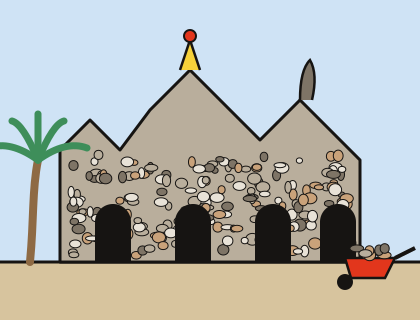
As villages were cleared for the new city, Nek Chand began collecting the waste: broken tiles, pottery, glass, bangles, sinks, toilets, electrical fittings and stones. He took them on his bicycle to a gorge in a forest near Sukhna Lake, on government land where building was forbidden. Sources date the start of the collecting to the late 1950s and the building to the 1960s.
Working at night and in his spare time, he cleared a small patch and began making figures: concrete shaped over frames, often recycled bicycle frames, and covered in fragments of his collected waste. Over the years his secret kingdom grew to many acres of courtyards, waterfalls and paths lined with dancers, soldiers, animals, birds and village people, often arranged in great ranks.
What happened when it was discovered?
Government officials found the garden in the 1970s; sources give 1972 or 1975. Because it was built illegally on protected land, it could have been demolished. Instead, public support and the admiration of officials led the authorities to put it under official supervision. Nek Chand was given a salary, the title Sub-Divisional Engineer, Rock Garden, and about 50 labourers so he could work on it full time. The Rock Garden opened to the public in 1976.
How big is the Rock Garden?
Estimates vary with the date and the source, from about 12 acres when it was discovered to 30 or 40 acres today. It contains thousands of sculptures. It is regularly described as one of the largest folk art environments in the world and draws thousands of visitors a day.
Has the Rock Garden been under threat?
Yes, more than once. In 1990, while Nek Chand was abroad on a lecture tour, the city withdrew funding and vandals damaged the garden. Supporters formed the Rock Garden Society to look after it, and the Nek Chand Foundation has helped raise money and awareness and works with the authorities to maintain the garden. In 2025 part of the garden's outer wall was demolished for road and parking works, which led to protests.
How was Nek Chand recognised?
Nek Chand received India's Padma Shri, one of its highest civilian honours, in 1984, and the Grand Medal of Vermeil from the city of Paris in 1980. The garden appeared on an Indian postage stamp in 1983. His work has been shown in museums in Britain, France and the United States, and he made a garden for the National Children's Museum in Washington, DC. He died in Chandigarh on 12 June 2015, aged 90.
How do you visit the Rock Garden?
The Rock Garden is in Sector 1 of Chandigarh, near Sukhna Lake, and is open daily for a small entry fee. Allow two to three hours to explore the winding paths, and visit early on weekdays to avoid the crowds. Opening hours change with the season, so check locally before you go.
Why does the Rock Garden matter?
The Rock Garden is one of the world's great works of outsider art, and one of the very few to become a major public attraction while its maker was alive. In a city designed by one of the 20th century's most famous architects, a road inspector working with rubbish created the place many visitors love most.
Where to go next
Read what is a visionary environment? or compare the garden with the Watts Towers.
Sources and further reading
Didn't find your answer?
Ask us about outsider art, an artist, a place or UK graffiti. We read every question, and the most useful ones are answered on the site.