Facteur Cheval's Palais Idéal: 33 Years, One Postman
A country postman picked up a strange stone in 1879 and spent the next 33 years building a palace from stones gathered on his rounds.

By The Outsider Artist editors, Editorial team, Website Studio
Updated
· Last reviewed · 3 min read
In short
- The Palais Idéal is a fantastical stone palace in Hauterives, Drôme, in south-east France, built by the postman Joseph Ferdinand Cheval (1836–1924).
- Cheval built it single-handed over 33 years, from 1879 to 1912, using stones he picked up on his rural post round.
- An inscription records the work as "10,000 days, 93,000 hours, 33 years of toil".
- France's culture minister André Malraux had it classified as a historic monument in 1969, against the advice of many officials.
- Cheval also built his own elaborate tomb in the Hauterives cemetery, where he is buried.
Who was Facteur Cheval?
Joseph Ferdinand Cheval was born in 1836 in the Drôme, in south-east France. He had little schooling and worked as a baker before becoming a facteur rural, a country postman, in the hills around Hauterives. His round covered many kilometres on foot every day.
How did the Palais Idéal begin?
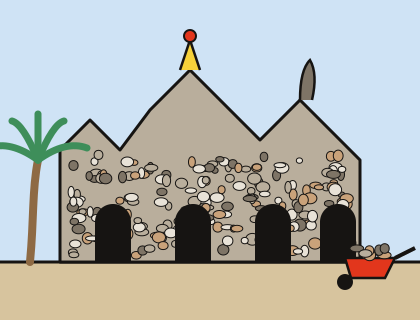
In April 1879, according to Cheval's own account, he tripped over a strangely shaped stone on his round. Its form reminded him of a dream he had had years earlier of a fairy-tale palace. He began picking up unusual stones as he walked, first in his pockets, then in a basket, and finally with a wheelbarrow that he pushed along his route.
At home, in his garden, he began to build. From the age of 43 he spent his evenings, weekends and days off working on it. He kept going for 33 years.
What does the Palais Idéal look like?
The palace is about the size of a large house, encrusted all over with stones, shells and moulded cement. It mixes the architecture of the whole world as Cheval imagined it from postcards and magazines: a Hindu temple, a mosque and a medieval castle, alongside giants, animals, palm trees, grottoes and staircases. Inscriptions in Cheval's own words are carved across it, celebrating work, nature and the dream that drove him.
Above one entrance he recorded the scale of the task: 1879 to 1912, 10,000 days, 93,000 hours, 33 years of toil. The name Palais Idéal came from a poem by a young writer, Émile Roux-Parassac, who visited in 1904.
What happened after it was finished?
Cheval had hoped to be buried in his palace, but the authorities refused. Instead, in his late seventies, he spent about eight more years building an elaborate tomb in the Hauterives cemetery in the same style. He died in 1924, aged 88, and is buried there.
How was the Palais Idéal saved?
For decades the palace was mocked as the work of an eccentric. It was admired by the Surrealists, including André Breton, but many locals saw it as a monument to madness. In September 1969 the culture minister André Malraux, defying experts who called it ugly, had it classified as a monument historique, a national historic monument. Restoration followed in the 1980s.
The palace is owned by the commune of Hauterives and is now one of France's best-loved monuments. In 2020 it came second in a national TV vote for the French public's favourite monument. Local authorities have explored a bid for UNESCO World Heritage status.
How do you visit the Palais Idéal?
The Palais Idéal is at 8 rue du Palais, Hauterives, in the Drôme, between Lyon, Grenoble and Valence. It is open to visitors most of the year, with shorter hours in winter. The nearest large railway stations are at Valence and Lyon, and most visitors arrive by car. Allow at least two hours, and add a short walk to Cheval's tomb in the village cemetery. Check the official website for current opening times and prices before you travel.
Why does the Palais Idéal matter?
The Palais Idéal is the classic visionary environment, and one of the first works of what we now call outsider art to be officially protected. It shows what one person, with no training and very little money, could achieve through sheer persistence. It also influenced generations of artists, from the Surrealists to builders of later environments around the world.
Where to go next
Compare it with the Watts Towers, built by another man working alone for 33 years, or read what is a visionary environment?
Sources and further reading
- The Local France: Have you visited this unworldly palace built by a French postman?
- Banque des Territoires: Le Palais du facteur Cheval vise l'inscription au patrimoine mondial
- Slate.fr: Le facteur Cheval, l'idiot qui a rempli son jardin de pierres pendant 33 ans
- Collection de l'Art Brut: Centennial of the Palais Idéal (2012)
Didn't find your answer?
Ask us about outsider art, an artist, a place or UK graffiti. We read every question, and the most useful ones are answered on the site.