What Is a Visionary Environment?
A home, garden or plot of land transformed into a single work of art, usually by one self-taught person over many years. What they are and why so many are lost.

By The Outsider Artist editors, Editorial team, Website Studio
Updated
· Last reviewed · 3 min read
In short
- A visionary environment is a building, garden or site transformed by one person, usually self-taught, into a single immersive work of art.
- Famous examples include Facteur Cheval's Palais Idéal in France, Simon Rodia's Watts Towers in Los Angeles and Nek Chand's Rock Garden in India.
- They are typically built over decades from found and recycled materials: stones, broken crockery, glass, scrap metal and cement.
- Many have been destroyed after their makers died; those that survive often owe it to campaigners and heritage listing.
- In 2024, Ron's Place in Birkenhead became the first outsider art environment to be listed in England.
What counts as a visionary environment?
A visionary environment, sometimes called an art environment or fantasy world, is a large-scale, personal creation that a visitor can walk into or around. It might be a decorated house, a sculpture garden, a tower, a grotto or a whole landscape. The maker usually builds it alone, by hand, over many years, following a private vision rather than any plan or style.
Most makers had no training in art or architecture. Many were labourers, craftsmen or tradespeople who used the skills they had: a tile setter, a postman with a wheelbarrow, a joiner, a road inspector. This is why visionary environments are closely linked with outsider art.
What are visionary environments made from?
Almost always from whatever was to hand, often other people's rubbish:
- Stones collected on walks or rounds
- Broken crockery, tiles and glass set into cement as mosaic
- Bottles, shells, bangles and bottle caps
- Steel reinforcing bars, wire mesh and scrap metal
- Concrete and cement, shaped by hand
The use of discarded material is part of their meaning. Makers often describe turning waste into something beautiful as a moral or spiritual act.
What are the most famous examples?
- Palais Idéal du Facteur Cheval, Hauterives, France
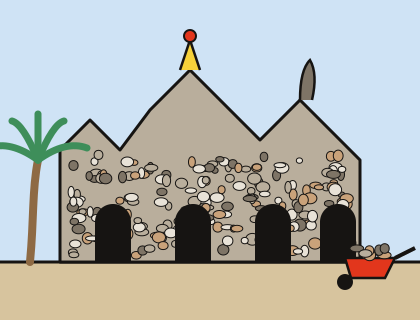
- A fantastical palace built by the postman Ferdinand Cheval from 1879 to 1912, from stones collected on his rounds.
- Watts Towers, Los Angeles, USA
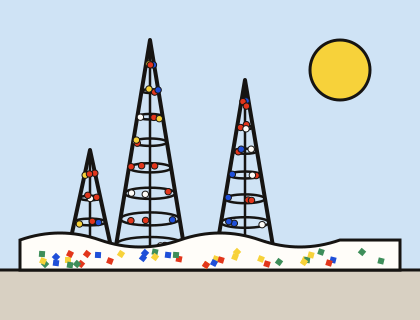
- Seventeen structures, including spires nearly 30 metres high, built single-handed by the Italian immigrant Simon Rodia from 1921 to 1954.
- Nek Chand's Rock Garden, Chandigarh, India
- A vast garden of thousands of sculptures made from industrial and household waste, begun in secret by a government road inspector.
- La Maison Picassiette, Chartres, France
- A house covered inside and out in mosaics of broken crockery and glass by Raymond Isidore, a cemetery sweeper, from about 1938. It was listed as a historic monument in 1983 and is now a museum owned by the city.
- Paradise Garden, Summerville, Georgia, USA
- The garden and museum of the preacher Howard Finster, begun in 1961, who said a vision in 1976 told him to make sacred art. It is open to visitors.
Are there visionary environments in Britain?
Yes, though fewer famous ones. Ron Gittins's flat in Birkenhead, Ron's Place, was listed Grade II in 2024. Others include John Fairnington's Cement Menagerie, Gerry Dalton's Gerry's Pompeii in Paddington and Rory McCormack's Brighton Flint Grotto. See visionary environments in Britain.
Why are so many visionary environments lost?
Visionary environments are among the most fragile kinds of art:
- They are tied to property. When the maker dies or moves, the house or land is sold, and new owners rarely want a cement menagerie.
- They are often unauthorised. Many were built without planning permission and face demolition orders.
- They are hard to maintain. Weather, vandalism and the cost of conservation take a toll.
- They are not recognised as art until it is too late.
The Swiss maker Armand Schulthess, for example, turned a hillside of nearly 18,000 square metres in Ticino into an open-air environment from the 1950s. It no longer exists; the Collection de l'Art Brut acquired more than 300 of its objects in 2024 and shows them from November 2026.
How are they saved?
Usually by local people. The Watts Towers survived a demolition order in the 1950s because a committee of residents and supporters proved they were safe. The Palais Idéal was protected as a historic monument in 1969 against official advice. Ron's Place was bought by a community land trust in 2023. Organisations such as SPACES Archives in the US document environments before they disappear.
Can you visit them?
Many are open to the public, some only by appointment. Always check opening times before you travel, and remember that some environments are private homes. Our where to see directory lists those you can visit.
Where to go next
Start with the Palais Idéal, the most famous of all, or explore Britain's environments.
Questions and answers
What is a visionary environment?
A visionary environment is a home, garden or site transformed by one person, usually self-taught, into a single work of art. Famous examples include the Palais Idéal in France, the Watts Towers in Los Angeles and Nek Chand's Rock Garden in India. Read more.
Sources and further reading
Didn't find your answer?
Ask us about outsider art, an artist, a place or UK graffiti. We read every question, and the most useful ones are answered on the site.