Visionary Environments in Britain: Grottoes, Menageries and Hidden Worlds
From a flint grotto on Brighton beach to a concrete zoo in Northumberland: Britain's self-built art environments, and what has survived.

By The Outsider Artist editors, Editorial team, Website Studio
Updated
· Last reviewed · 3 min read
In short
- Britain has fewer famous visionary environments than France or the US, and many have been lost.
- Ron's Place in Birkenhead, listed Grade II in 2024, is the best preserved and the first to be nationally listed.
- The Brighton Flint Grotto, built from 2013 to 2020 by the fisherman Rory McCormack, stands on Brighton beach.
- John Fairnington's Cement Menagerie of about 300 concrete figures moved from Branxton, Northumberland, to Ayton Castle in the Scottish Borders after 2021.
- Gerry Dalton's Gerry's Pompeii in Paddington was largely dismantled after his death in 2019.
Why are there so few in Britain?
Nobody knows how many British environments have existed, because many were never recorded. The film-maker Martin Wallace, who made the television series Journeys into the Outside with Jarvis Cocker in the late 1990s, has pointed out that the UK has little known history of visionary environments compared with the US or France. Small gardens, high property values, rented homes and planning rules all work against them, and many disappear when their makers die.
Ron's Place, Birkenhead
Ron Gittins spent more than 30 years, from 1986 to 2019, transforming his rented flat at 8 Silverdale Road, Oxton, into a world of ancient Egypt, Greece and Rome, with massive cement fireplaces, a Minotaur's head and a Roman altar in the kitchen. A community land trust bought the house in 2023, and it was listed Grade II in March 2024. Read the full story of Ron's Place.
The Brighton Flint Grotto
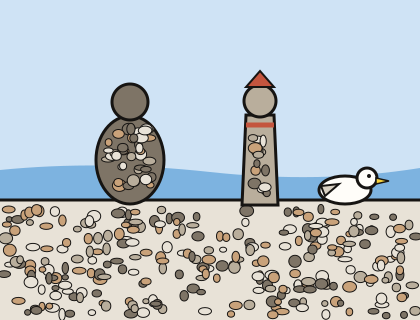
On a small beach plot allocated for storing fishing boats and nets, the fisherman and former dry-stone waller Rory McCormack built a sculpture garden of flint, shells and red brick between 2013 and 2020. His figures are enlarged copies of ancient sculptures, including the Venus of Willendorf, a Cycladic harp player and the Dancing Girl of Mohenjo-daro, along with a gorilla, an orangutan and a herring gull. He built it without permission, and in 2015 the council described the larger statues as a safety risk. It was first documented online in 2015 and featured in Raw Vision in 2017.
The grotto is visible from the beach near the fishing quarter. Please treat it as a working plot and do not climb on the figures.
The Cement Menagerie, Branxton
John Fairnington (1883–1981), a retired joiner, began making concrete animals and figures in his garden at Branxton, Northumberland, after he retired in 1961, and worked on them until about 1971. Researchers believe he made them to entertain his son Edwin, who had cerebral palsy, and the garden also became a memorial to his wife, Mary. There are about 300 figures, mostly animals such as horses, zebras and crocodiles.
In 2021 Fairnington's great-niece put the collection up for sale, and Ayton Castle in the Scottish Borders bought it. The sculptures are being restored for permanent display there. Check with Ayton Castle before visiting.
Gerry's Pompeii, Paddington
Gerry Dalton (1935–2019), an Irish-born former gardener, filled the garden of his council flat at 34A Hormead Road, Paddington, with concrete and clay figures of historical characters, from Oliver Cromwell to Prince George of Denmark, and decorated the interior with models of buildings such as Hampton Court and Buckingham Palace. He began after retiring in the 1990s.
After his death in October 2019, supporters campaigned to keep the flat intact and even occupied it to protect it. The family removed his work in 2020, and by 2025 only a small part survived, on display along a stretch of the Grand Union Canal. A documentary, Gerry's Pompeii, was released in 2023.
Shell gardens and grottoes
Britain has a long tradition of shell decoration, from the mysterious Shell Grotto in Margate to 18th-century garden grottoes built for wealthy landowners. These are not outsider art in the strict sense: many were professionally made or are of unknown origin. But the 20th century also produced self-built shell gardens by private individuals. Raw Vision has singled out George Howard's shell garden at Southbourne, Dorset, alongside the Cement Menagerie, as among the best known of Britain's modest environments.
How can you help protect them?
- Record them: photograph environments you know of and share them with organisations such as SPACES Archives.
- Support campaigns to save threatened sites, and community trusts like the one that bought Ron's Place.
- Respect the makers: many environments are private homes. Never trespass.
- Tell us about environments we have missed through our contact page.
Where to go next
Read what is a visionary environment?, or plan a visit with our where to see directory.
Sources and further reading
Didn't find your answer?
Ask us about outsider art, an artist, a place or UK graffiti. We read every question, and the most useful ones are answered on the site.