The Watts Towers: Simon Rodia's Nuestro Pueblo
An Italian immigrant tile setter spent 33 years building towers nearly 30 metres high in his Los Angeles back yard, then gave them away and left.

By The Outsider Artist editors, Editorial team, Website Studio
Updated
· Last reviewed · 3 min read
In short
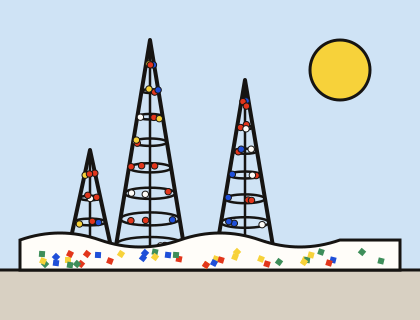
- The Watts Towers are 17 interconnected structures in Watts, Los Angeles, built by Sabato "Simon" Rodia (1879–1965) between 1921 and 1954.
- Rodia built them single-handed from steel rods, wire mesh and mortar, decorated with broken tiles, bottles, pottery and shells.
- The tallest towers are nearly 30 metres (about 100 feet) high.
- Rodia called the work Nuestro Pueblo, "Our Town"; in 1954 he gave the property to a neighbour and left Los Angeles for good.
- Campaigners saved the towers from demolition in 1959; they became a US National Historic Landmark in 1990.
Who was Simon Rodia?
Sabato Rodia, known as Simon or Sam, was born in Serino, near Naples in southern Italy, in 1879 (some sources say 1886). As a teenager he emigrated to the United States with his brother. He worked in quarries, logging and railway camps and as a construction worker and tile setter, picking up the skills he would later use. In 1921 he bought a small triangular plot at 1765 East 107th Street in Watts, then a mixed working-class neighbourhood of Los Angeles, and began to build.
How did Rodia build the towers?
Rodia worked alone, without machinery, using the simplest tools. He bent steel reinforcing rods into shape, wrapped them in wire mesh and covered them in hand-mixed mortar. Into the wet mortar he pressed thousands of fragments: broken tiles and dishes, coloured bottle glass, seashells, mirrors and pottery, including pieces from the Malibu Pottery where he had worked. He reportedly walked the railway line as far as Wilmington, nearly 20 miles away, looking for materials.
A popular story says he used no scaffolding or ladders at all, climbing the towers as he built them. Photographs show ladders on the site, so the legend is at least exaggerated.
What is at the Watts Towers site?
The site includes 17 structures. The best known are three tall spires, the highest nearly 30 metres, alongside smaller towers, walls, a gazebo, a fountain, a fishpond and a ship. Every surface is decorated. Rodia called the whole work Nuestro Pueblo, Spanish for "Our Town".
Why did Rodia leave?
In 1954, after 33 years of work, Rodia, then about 75, suffered a fall from one of the towers. Shortly afterwards he gave the property to a neighbour and moved to Martinez in northern California to be near relatives. He never returned and showed little interest in what happened to the towers. His reasons have never been fully explained, though he had faced years of vandalism and suspicion from some neighbours. He died in 1965, a month before the Watts uprising, which the towers survived undamaged.
How were the Watts Towers saved?
In 1957 the city of Los Angeles ordered the towers demolished as unsafe. In 1958 the film editor William Cartwright and the actor Nicholas King bought the property for $3,000 and formed the Committee for Simon Rodia's Towers in Watts. In 1959 the committee arranged a public load test in which a crane pulled on the tallest tower with a force of 10,000 pounds. The tower did not move, and the demolition order was dropped.
The committee cared for the towers until 1975, when it gave the property to the city of Los Angeles. The towers were added to the National Register of Historic Places in 1977 and became a National Historic Landmark in 1990. The neighbouring Watts Towers Arts Center runs programmes for the local community.
How do you visit the Watts Towers?
The towers are at 1765 East 107th Street in Watts, South Los Angeles, and are part of the Watts Towers of Simon Rodia State Historic Park. You can see them from the street, and guided tours take you inside the walls on set days. Check the Watts Towers Arts Center or the city's cultural affairs department for current tour times before you go.
Why do the Watts Towers matter?
The Watts Towers are one of the world's most famous works of outsider architecture, and a symbol of pride for the Watts community. They show what one immigrant labourer, with no plans and no help, could build from the city's waste. Rodia even appears among the faces on the cover of the Beatles' Sgt. Pepper's Lonely Hearts Club Band.
Where to go next
Compare the towers with Facteur Cheval's Palais Idéal, also built over 33 years, or with Nek Chand's Rock Garden.
Sources and further reading
Didn't find your answer?
Ask us about outsider art, an artist, a place or UK graffiti. We read every question, and the most useful ones are answered on the site.